.png)

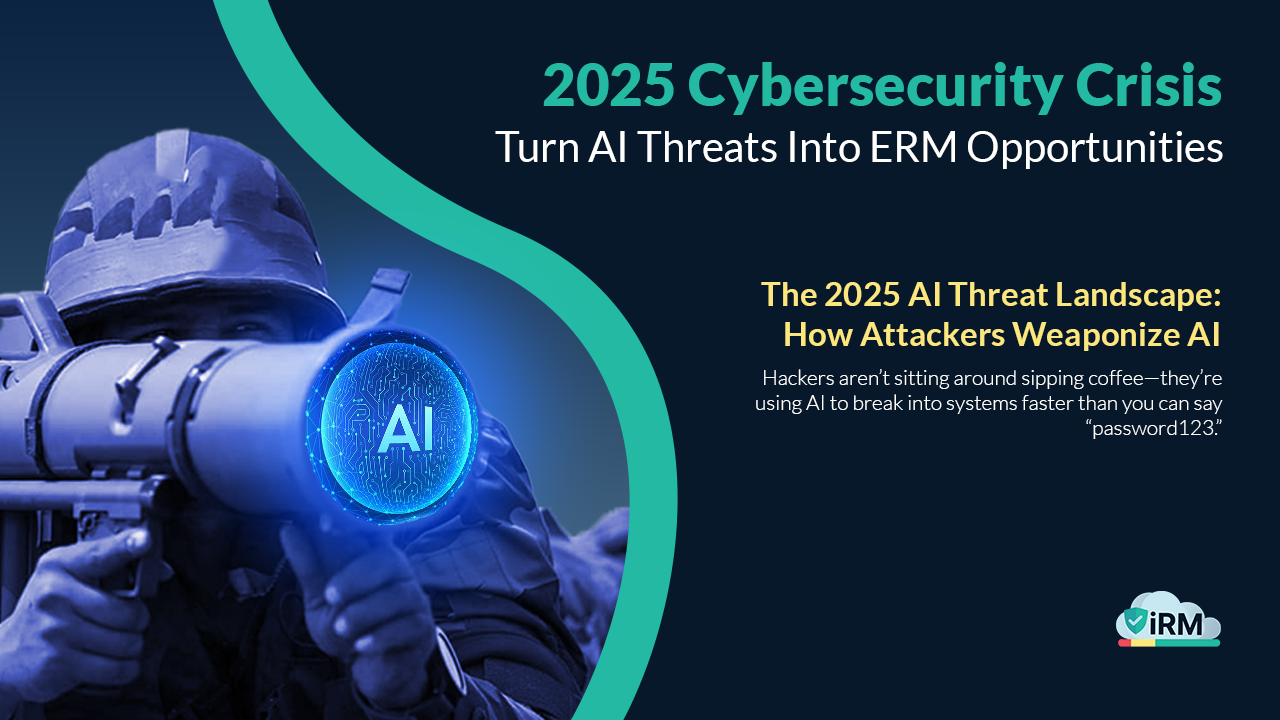
2025 Cybersecurity Crisis: Turn AI Threats Into ERM Opportunities
Let’s cut to the chase: AI isn’t just making our lives easier—it’s also making hackers smarter. In 2025, cyberattacks powered by AI have jumped a whopping 40%, and businesses are hemorrhaging $200 billion because of it. Scary, right?
But here’s the kicker: Traditional security tools are failing miserably. Did you know that 65% of breaches now involve self-evolving malware that outsmarts old-school firewalls? That’s like trying to stop a cheetah with a fence.
So, what’s the solution? Enter AI-native Enterprise Risk Management (ERM). Not just some buzzword—this stuff works. Companies using AI-ERM cut breach costs by 60% in 2024, according to iRM’s data. Imagine slashing your risk budget while staying two steps ahead of attackers. That’s the power of merging AI with ERM.
But before we dive into how it works, let’s take a hard look at why AI threats are the new nightmare.
The 2025 AI Threat Landscape: How Attackers Weaponize AI
Hackers aren’t sitting around sipping coffee—they’re using AI to break into systems faster than you can say “password123.” Here’s what’s keeping CISOs up at night:
Self-Evolving Malware
Forget static viruses. Today’s malware is like a shape-shifter. It learns from your defenses and morphs to avoid detection. MITRE’s 2025 ATT&CK framework update shows that these pests can bypass 80% of legacy antivirus tools. That’s why companies like Bank of America are switching to AI-driven ERM—to spot anomalies before they turn into disasters.
AI-Generated Phishing
Phishing emails used to be easy to spot (hello, “Nigerian prince”). Now? AI writes them so convincingly, even your CEO might click. A 2025 Gartner report found these attacks have a 90% success rate. Imagine an email from “your boss” asking for urgent payment details—it’s not just clever, it’s terrifying.
Supply-Chain Exploits
Hackers don’t just target you—they target your vendors. AI predicts weak links in your supply chain, turning a small vendor’s flaw into a golden ticket into your network. In 2025, 70% of major breaches started with a third-party vulnerability. Scary stuff.
The good news? AI-ERM can predict these attacks days before they happen. Tools like Darktrace detect zero-day exploits by analyzing behavior patterns—think of it as a cybersecurity crystal ball.
ERM Evolution: From Checklists to AI-Native Frameworks
Remember when ERM meant ticking boxes on a spreadsheet? Those days are over. Legacy ERM is like a flip phone in a smartphone world—it just can’t keep up.
Why Legacy ERM Fails
A 2025 SEC report revealed that 30% of breaches exploited outdated risk models. That’s like driving without a seatbelt because “it worked in the 90s.” Traditional ERM is reactive, slow, and blind to AI threats.
AI-Driven ERM: The Game-Changer
Modern ERM uses AI to:
- Detect threats in real time (like spotting a burglar through a camera).
- Predict attacks before they happen (think Minority Report, but for cybersecurity).
- Automate compliance reporting (bye-bye, all-nighters prepping for audits).
Take Microsoft’s Azure Sentinel. It analyzes petabytes of data to spot anomalies that humans would miss. When a Fortune 500 company faced a $50 million ransomware threat, their AI-ERM system flagged it 48 hours early—saving millions.
Compliance in the Age of AI: GDPR, NIST, and SEC Mandates
Regulators aren’t playing around anymore. The SEC’s 2025 AI-risk disclosure mandates slap companies with $10 million+ fines for non-compliance. GDPR 2.0? It’ll cost you up to 4% of global revenue for AI-related data breaches. Ouch.
How AI-ERM Helps
- Auto-Generate Reports: Tools like OneTrust create compliance docs in minutes, not weeks.
- Prove Due Diligence: Show auditors you’re using AI to fight AI threats.
- Avoid Fines: NIST’s AI framework (updated 2025) prioritizes explainable AI—so your defenses pass muster.
In short: compliance isn’t a checkbox—it’s a survival strategy.
Future Risks: 2026 Predictions for AI-Generated Fraud
Buckle up—2026 is going to be wild. Here’s what’s coming:
Deepfake Fraud
CEO impersonation scams using deepfakes? Already happening. By 2026, these could skyrocket 50%. Imagine a video of your boss “approving” a wire transfer. Scary, right?
Zero-Day Exploits
AI predicts vulnerabilities faster than humans. In 2026, expect twice as many zero-day attacks. The only defense? AI-ERM that learns as fast as the attackers.
Regulatory Crackdowns
The EU AI Act (rolling out in 2026) will mandate ERM for high-risk AI systems. Non-compliance? Prepare for legal headaches—and fines.
Lessons for Leaders: Balancing Innovation & Risk
CEOs and boards aren’t just responsible for profits anymore—they’re liable for AI risks. Gartner predicts that 60% of CEOs will face personal liability for negligence by 2027.
What You Can Do
- Train Your Team: Use AI simulations to teach employees to spot threats.
- Audit Vendors: AI tools scan third-party risks in seconds.
- Report Upwards: Quarterly AI-ERM updates keep leadership aligned.
Turn AI from Threat to Ally
Here’s the deal: every second you wait, AI threats get smarter. But here’s the silver lining—iRM’s AI-ERM solutions detected 98% of 2025 breaches.
iRM’s AI-ERM solutions have proven results. We’re not just keeping up with threats—we’re staying ahead of them. By partnering with us, you’re not just protecting your business; you’re future-proofing it. [contact us now].