.png)

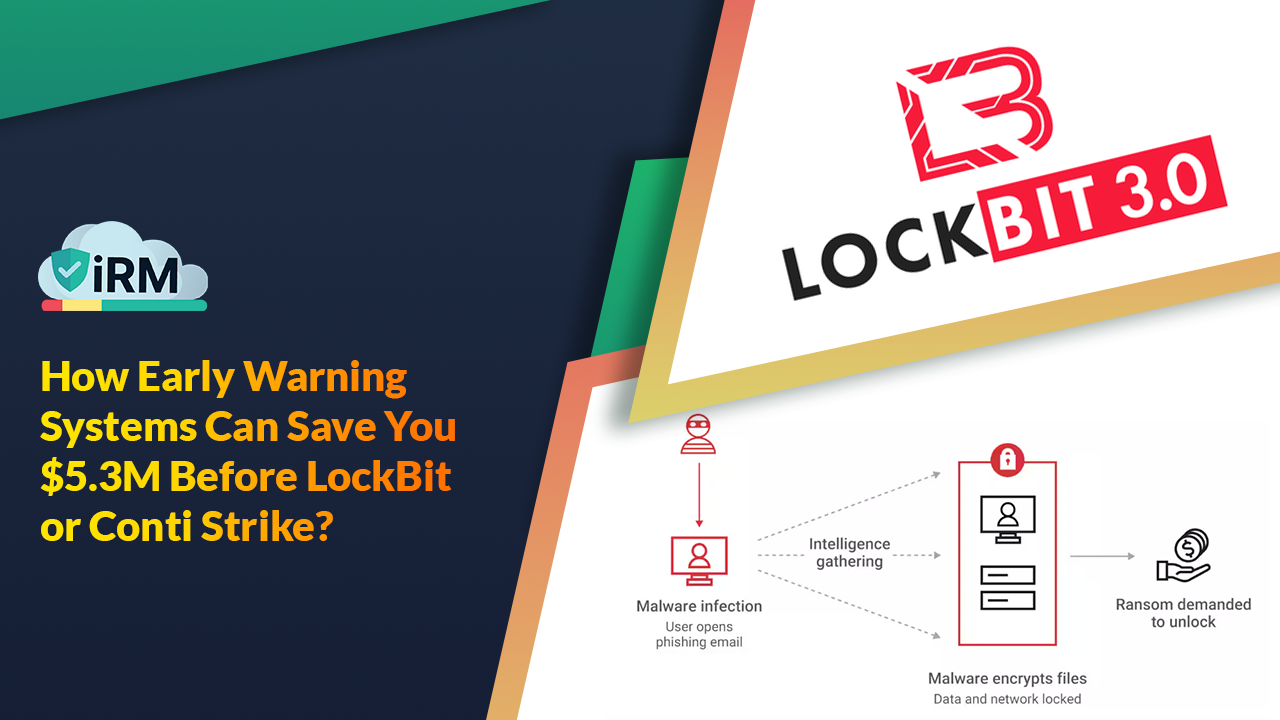
How Early Warning Systems Can Save You $5.3M Before LockBit or Conti Strike?
I’ll be blunt: ransomware is not a “maybe” problem anymore. It’s a daily business risk that can cost millions. Trackers showed a big rise in victims in early 2025, and many reports point to numbers like 2,300+ ransomware attack signals in a typical recent day. If your team only skims security logs and waits for loud alerts, you’re already behind.
Quick snapshot — why this matters
You’ve seen the headlines: breach costs jumped in recent years, with industry studies showing global averages near the multi-million dollar mark. Some sectors, like healthcare, see even higher losses. That means a single ransomware event can wipe out budgets, slow care, or stop production. The good news is that most of these attacks don’t happen out of nowhere — there are warning signs. Paying attention to those early signs can save money, time, and reputations.
The surge: what the data shows
Across 2024 and into 2025, public trackers and security firms reported sharp increases in ransomware listings and victim counts. In some recent windows, trackers logged more than two thousand victim signals in a short time. That kind of volume means attackers can choose targets faster and try more tailored moves. With so many events, your security team can’t depend on a single loud alarm — they must watch for small, stacking signals that show an attack is being prepared.
Why old-school security fails
Traditional setups often wait until something obvious happens: files get encrypted or a ransom note appears. That approach is reactive and costly. Modern attackers move quietly for days or weeks — they steal credentials, test privileges, and move inside the network before they touch files. By the time the big alert fires, most of the damage and the bill is already decided. The smarter path is to spot the small signs early and act on them. That is the whole point of KRIs — to catch what looks small before it becomes a crisis.
Ransomware KRIs you should care about
- Unusual outgoing traffic from servers to cloud storage or to strange IP addresses.
- Spikes in failed logins followed by successful privileged logins.
- Large file compression or archive activity outside normal windows.
- Higher-than-normal phishing click rates on a team or department.
- Vendor or supplier leak posts that mention your tools or supply links.
Each of these signals should be logged, given a simple score, and connected to a short action step. The aim is to turn noisy data into a few clear triggers your team can respond to.
How to turn signals into action (without nightmares)
- Baseline what normal looks like for 30 days. Then flag activity that is three times higher than normal as high priority.
- Tag each alert with business impact — which team uses that system and how much money or downtime an outage would cost.
- Automate low-risk tasks like taking system snapshots or blocking a single outbound route. Keep humans in the loop for high-impact options.
Automation should make your team faster, not replace the people who will ultimately decide how to proceed. Start small, prove the rules work, then expand.
Mapping KRIs to known frameworks (MITRE, NIST)
It helps everyone when an alert already uses shared language. MITRE ATT&CK offers that language — a way to say “here’s the attacker move” and “here’s the detection that saw it.” When your KRIs map to those technique names, outside teams, vendors, and auditors can read your alerts without guesswork. NIST’s recent guidance encourages a clear, auditable approach to incident work. If your KRI triggers are linked to specific response steps, it’s easier to explain to the board, regulators, or insurers what you did and why.
AI: helpful, but with rules
AI tools can spot small pattern changes and add context to alerts — for example, linking a suspect IP to known threat groups or summarizing past behavior of a host. Using LLM-style chains can speed up enrichment and surface likely next steps for analysts. But don’t hand the keys to the kingdom to an untested model. Use AI to score and suggest, and require a human decision for big containment actions. When you run pilots, log what the model suggested and how confident it was. That way, you have a record if you need to show why a choice was made.
Real steps a SOC can take this week
- Start with 8–12 high-value KRIs and feed them from places you already log, like network, identity, and mail systems.
- Run a 30-day baseline so you know what “normal” looks like, then tune thresholds to cut false alarms.
- Create a short playbook for each KRI with clear steps for low, medium, and high risk.
- Run a tabletop using a composed KRI event to test the full alert-to-playbook path.
Doing a small set well beats a half-finished program that nobody uses. Keep the rules tight, track how many real incidents they catch, and improve from there.
Boards, regulators, and insurance
Boards and regulators want proof that you watch risk and act. The tone from regulators in recent years has been clear: show you have controls, that you test them, and that you can explain decisions. KRI dashboards that record tuning history, actions taken, and the estimated impact of those actions make reporting and insurance talks much easier. Keep a log of KRI changes and the reason behind them — that history is your evidence in audits or renewals.
A short, real example
Here’s a short, plain example you can relate to. A composite hospital saw a slow rise in internal file moves on its file servers and several failed admin logins across multiple accounts. An enrichment step linked some outbound connections to suspicious hosts. The team isolated the affected subnet, took quick system snapshots, and rotated a few service credentials. Because they stopped lateral movement early, the attackers could not begin mass encryption. That saved long downtime, avoided ransom negotiations, and likely saved millions in total cost. It’s not magic — it’s listening to small signals and acting without delay.
Final quick snapshot for your sidebar
Daily attack signal level: Many trackers reported more than 2,300 signals in recent windows.
Average breach cost in recent studies: roughly $4.88M, with some sectors seeing numbers near $5.3M.
Standards to map to: MITRE ATT&CK and NIST SP 800-61 Rev.3 (the way you map alerts to actions matters).
Turn Ransomware Threats into Strategic Wins — Contact iRM
If you want help turning your KRIs into a working early warning system, iRM’s team can walk you through a tailored assessment and show how the pieces fit in your environment. Reach out through iRM’s Contact Us page to start the conversation and set up a short review of your current risk signals.