.png)

Insider Threats in 2025: Why AI is Your Best Defense
Let’s talk about something that’s probably giving you sleepless nights: insider threats. These are the risks hiding within your walls—employees, contractors, or trusted partners who, intentionally or accidentally, misuse their access to your systems. Insider threats aren’t a one-size-fits-all problem; they come in various forms. You’ve got malicious insiders, who deliberately sabotage or steal, negligent insiders, who slip up due to carelessness, and compromised insiders, whose credentials get hijacked by external attackers.
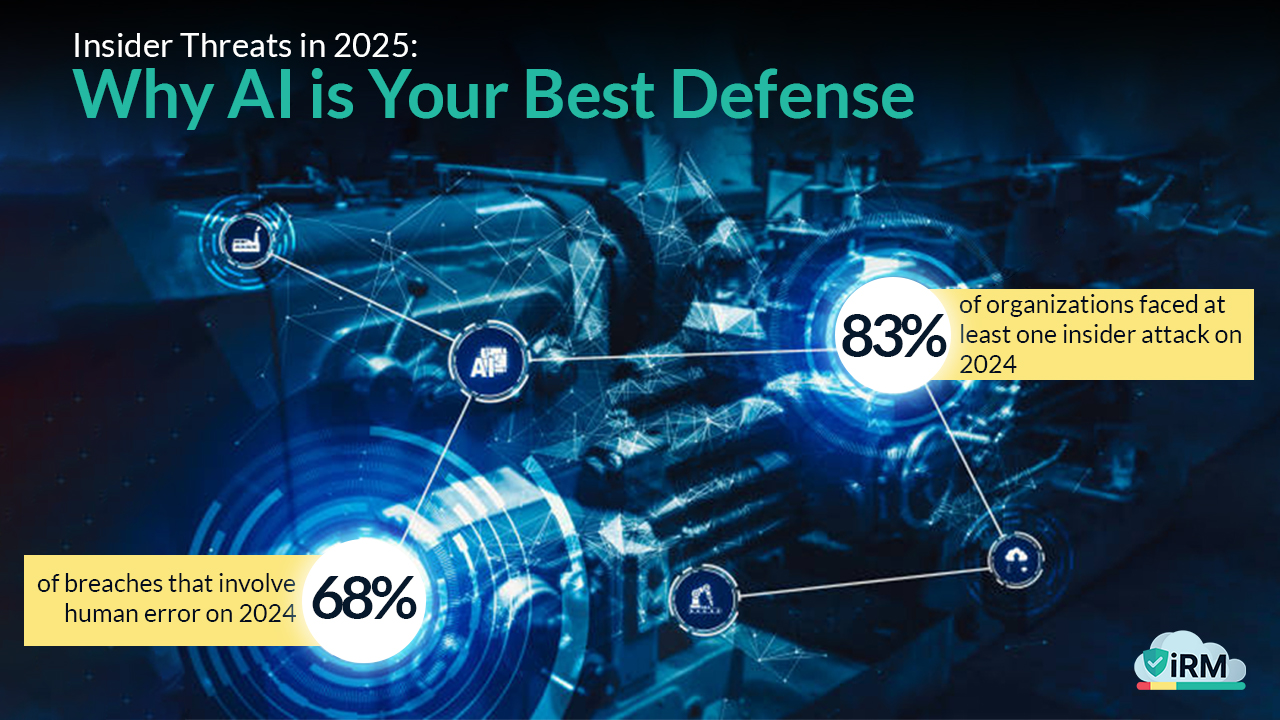
The stakes are high: the 2024 Insider Threat Report reveals that 83% of organizations faced at least one insider attack last year, while the Verizon DBIR 2024 notes that 68% of breaches involve human error, like falling for phishing scams or mishandling sensitive data. These numbers aren’t just stats—they’re a wake-up call. Fortunately, there’s a game-changing ally in this fight: artificial intelligence (AI). Stick with me as we unpack how AI can spot these threats before they turn into disasters.
How AI Works Its Magic
Imagine AI as a relentless, brilliant detective that never sleeps. It’s powered by machine learning, which studies how your users behave—tracking things like login times, file downloads, and data access habits. Over time, it builds a baseline of what’s “normal” for each user. When something odd pops up—like an employee logging in at 3 a.m. from a foreign country—AI doesn’t hesitate to sound the alarm.
It uses advanced techniques like anomaly detection to pinpoint outliers, user and entity behavior analytics (UEBA) to get a 360-degree view of user activity, and natural language processing (NLP) to scan emails or messages for red flags, such as phrases hinting at data leaks or discontent. What sets AI apart is its ability to process massive volumes of data in real time, spotting subtle patterns that traditional tools miss. Machine learning algorithms also evolve, getting sharper and more precise as they learn from new data. Unlike older, reactive security methods that wait for trouble to strike, AI is proactive—catching threats early and keeping your defenses rock-solid.
Real-World Wins
AI isn’t just hype—it’s proving its worth across industries. Let’s dive into some compelling examples:
In healthcare, a hospital (inspired by a CybersecAsia case study) deployed an AI-powered tool to monitor staff activity. One day, it flagged an employee accessing patient records they had no business touching—dozens of files outside their department. The AI, leveraging UEBA, caught this unusual pattern fast, stopping a potential HIPAA violation before sensitive data could be leaked or sold. Early detection saved the hospital from hefty fines and reputational damage.
In finance, a bank (echoing a scenario from the 2024 Verizon DBIR) used AI to oversee trading activities. An employee started executing trades that didn’t match their usual role or responsibilities. AI’s pattern recognition zeroed in on these anomalies, uncovering an insider trading scheme that could’ve led to millions in losses. By acting swiftly, the bank avoided financial disaster and regulatory scrutiny.
Meanwhile, in government, drawing from Booz Allen’s insights, a government agency relied on AI to protect classified data. A contractor began transferring unusually large volumes of files to an external drive—behavior that didn’t align with their normal workflow. AI flagged this in real-time, preventing a national security breach that could’ve had far-reaching consequences. Protecting sensitive information is critical, and AI delivered.
These cases show AI’s ability to act fast and decisively, making it a lifesaver across sectors.
Why This Matters Now
Insider threats aren’t just a growing problem—they’re an urgent crisis. The 2024 Insider Threat Report found that 83% of organizations encountered an insider attack last year, and the Verizon DBIR 2024 highlights that 68% of breaches stem from human error. These incidents are getting sneakier, with attackers using sophisticated tactics to fly under the radar.
The fallout can be devastating: financial losses from stolen assets, reputational damage that erodes customer trust, and legal liabilities from regulatory violations. Consider a financial institution from a Palo Alto Networks case study: a disgruntled employee leaked customer data for months, undetected by traditional tools. Static rules and human oversight simply can’t handle today’s flood of data or the subtlety of modern threats. AI changes the game with its predictive power and real-time analysis, catching risks that would otherwise slip through the cracks.
Limitations of Human Monitoring: Why We Need AI
Humans alone can’t keep up—here’s why, broken down into key points:
- Fatigue and Bias: People get tired and miss subtle clues. After hours of staring at screens, a security analyst might overlook a small but critical anomaly—like a slight uptick in file downloads. AI never blinks and isn’t swayed by bias, ensuring consistent vigilance.
- Data Overload: Organizations generate thousands of transactions daily. Manually sifting through this to spot a threat is like searching for a needle in a haystack—impossible without help. AI processes millions of data points instantly, finding patterns humans can’t.
- Delayed Response: Human reaction times lag. By the time a breach is noticed, the damage is often done—think of that financial institution losing data for months. AI’s real-time alerts stop threats before they escalate.
AI fills these gaps, offering speed, scale, and precision that human monitoring can’t match.
Challenges in Implementing AI Solutions
Rolling out AI isn’t a walk in the park. Privacy concerns are a big hurdle—monitoring user behavior involves sensitive data, raising ethical and legal questions. Organizations must strike a balance between security and privacy rights, complying with laws like GDPR or CCPA.
Then there’s the cost: integrating AI often means investing in new tech, upgrading infrastructure, and training staff. Speaking of staff, there’s a skill gap—not every team has the know-how to manage complex AI tools. Choosing the right solution is critical too; a poorly integrated system can disrupt workflows. Partnering with experts, like iRM, can smooth the process, delivering tailored AI solutions that fit your setup and goals.
Best Practices for Proactive Defense
Want to stay ahead of insider threats? Here’s your roadmap:
- Employee Training: Regular, engaging sessions on phishing, data handling, and spotting insider risks reduce accidental slip-ups. Think interactive workshops or phishing simulations to keep staff sharp.
- Continuous Monitoring: AI watches 24/7, flagging oddities like sudden spikes in file transfers or logins from strange locations—giving you eyes everywhere.
- Access Controls: Enforce least-privilege policies so users only access what they need. If someone goes off-script, the damage is contained.
- Incident Response: A clear, rehearsed plan ensures rapid reaction to threats. Pair this with regular audits to test and tweak your AI-driven defenses.
The Future of AI in Cybersecurity: What’s Next?
AI’s role in security is just beginning to unfold. Quantum computing could turbocharge its processing power, making threat detection lightning-fast and ultra-precise. Predictive analytics might soon anticipate threats—like flagging a disgruntled employee’s intent to steal based on subtle behavior shifts.
Other trends on the horizon include AI-driven threat hunting, where it proactively seeks out hidden risks, and automated incident response, slashing the time to neutralize breaches. These advancements promise smarter, more agile defenses, keeping you ahead of even the craftiest insiders.
With 68% of breaches tied to human error (Verizon DBIR 2024), waiting for threats to hit is a losing strategy. AI’s ability to learn, adapt, and predict makes it your strongest shield against insider risks. This isn’t just about tech—it’s about staying proactive in a world where threats evolve daily.
Ready to secure your organization? Reach out to today for a customized solution that fits your needs. Don’t delay—strengthen your defenses now and sleep a little easier tonight!