.png)

Navigating the Hidden Pitfalls in IT Governance, Risk Management, and Compliance
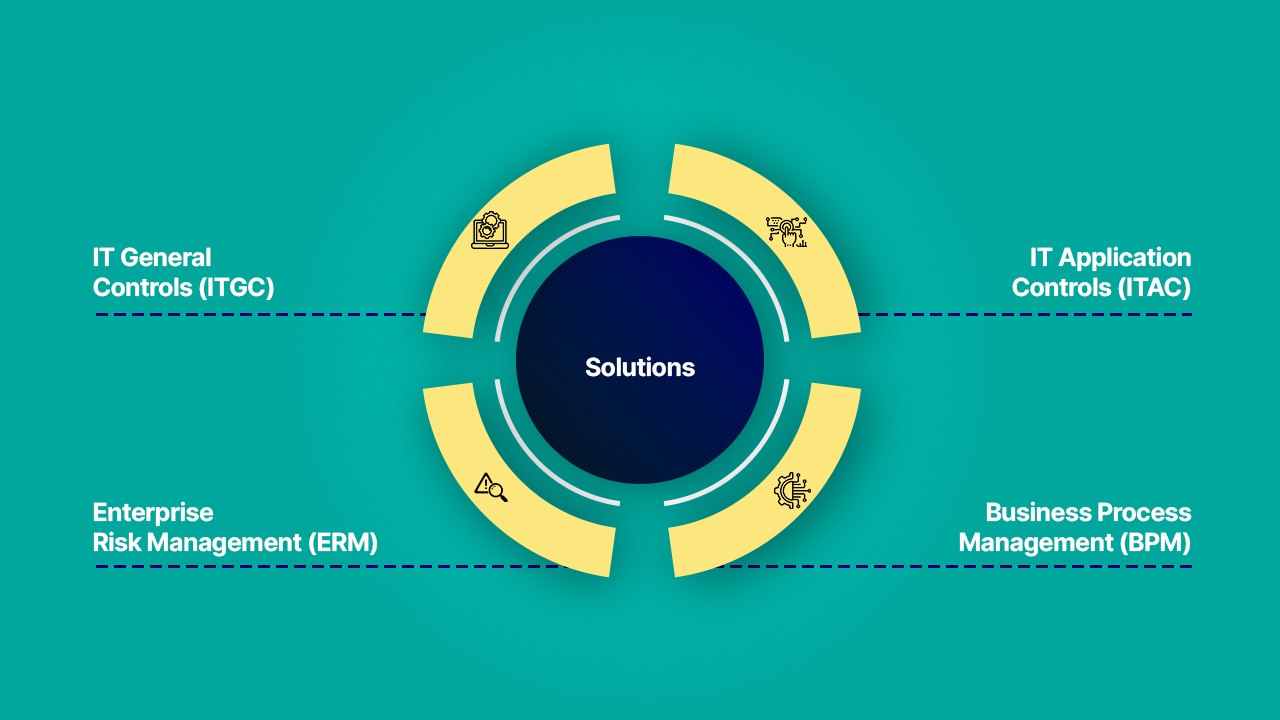
In today’s digital age, where technology underpins nearly every aspect of business operations, the importance of robust IT governance, risk management, and compliance (GRC) frameworks cannot be overstated. Companies are investing heavily in these areas to safeguard their operations, but what often goes unnoticed are the hidden challenges that can undermine these efforts. We’ll explore some of the most critical issues that organizations face in key domains such as Segregation of Duties (SoD), IT General Controls (ITGC), IT Application Controls (ITAC), Enterprise Risk Management (ERM), and Business Process Management. Understanding these challenges is the first step in addressing them effectively.
The Complexity of Segregation of Duties (SoD)
Balancing Efficiency with Risk Mitigation
Segregation of Duties (SoD) is a cornerstone of internal controls, designed to minimize the risk of fraud and error by ensuring that no single person has control over all critical aspects of a transaction. However, this control, while essential, is often difficult to manage in practice. The main challenge lies in balancing the need for stringent controls with the operational efficiency of the business.
For instance, in smaller organizations, employees often wear multiple hats, which can make strict SoD enforcement impractical without hiring additional staff. On the other hand, larger organizations might find that their complex structures lead to overlapping roles and responsibilities, making it hard to draw clear lines of separation. This complexity is exacerbated by the dynamic nature of modern business, where roles are constantly evolving. Without continuous monitoring and regular audits, SoD conflicts can easily go unnoticed, leading to significant risks.
The Solution?
Addressing SoD challenges requires a combination of automation and regular reviews. By leveraging advanced tools that automate role assignments and continuously monitor for conflicts, organizations can maintain a balance between control and efficiency. Learn More - https://www.irmcloud.app/blog/how-irm-can-save-your-business-millions-in-unseen-costs
IT General Controls (ITGC): The Unsung Hero of IT Security
The Challenge of Maintaining Consistency
IT General Controls (ITGC) form the bedrock of an organization’s IT infrastructure, ensuring that systems operate securely and reliably. However, despite their critical importance, ITGC often suffer from a lack of attention, particularly in organizations with diverse or decentralized IT environments.
One of the biggest challenges is maintaining a consistent control environment across all operations. This is particularly difficult in large organizations that operate across multiple locations and use a variety of IT systems. Differences in regulatory requirements across regions, coupled with varying levels of IT maturity, can lead to inconsistencies in how controls are applied.
Additionally, poor change management practices can lead to unauthorized changes in critical systems, which can compromise security and stability. Weak access controls further exacerbate the problem, increasing the risk of data breaches and unauthorized access.
The Solution?
To overcome these challenges, organizations must invest in robust change management processes and enforce strict access controls. Regular audits and the use of centralized IT management platforms can help maintain consistency and prevent unauthorized changes.
IT Application Controls (ITAC): Where the Details Matter
Configuration Challenges
IT Application Controls (ITAC) are essential for ensuring the integrity, accuracy, and security of data within applications. However, the devil is in the details. Even small errors in configuration can have significant consequences, leading to inaccurate data processing, financial discrepancies, or security vulnerabilities.
The challenge is particularly pronounced when integrating ITAC across multiple applications and systems. Each application may have its own unique set of controls, and ensuring they all work together seamlessly requires a deep understanding of both the technology and the underlying business processes.
Moreover, as businesses evolve, so too must their ITAC. Keeping these controls up to date with the latest business requirements and regulatory standards is a constant struggle, often requiring significant resources.
The Solution?
Effective ITAC management requires a proactive approach. Regular reviews, thorough testing of configurations, and ongoing training for IT staff can help minimize errors. Additionally, investing in tools that provide real-time monitoring and automated updates can significantly reduce the risk of misconfiguration.
Enterprise Risk Management (ERM): Seeing the Big Picture
The Challenge of Comprehensive Risk Management
Enterprise Risk Management (ERM) is all about seeing the big picture—identifying, assessing, and mitigating risks across the organization. However, this is easier said than done. The sheer volume and variety of risks that modern businesses face can make comprehensive risk management a daunting task.
One of the key challenges is risk identification. With so many potential risks—ranging from financial and operational to strategic and reputational—it’s easy to overlook critical threats. Even when risks are identified, quantifying them accurately is another major hurdle. Many organizations struggle to develop reliable models that can predict the impact and likelihood of various risks.
Integrating ERM with the overall business strategy is another significant challenge. Risk management is often treated as a separate function, disconnected from the strategic decision-making process. This disconnect can lead to risk management initiatives that are out of sync with the organization’s goals, reducing their effectiveness.
The Solution?
To address these challenges, organizations need to integrate ERM into their strategic planning processes. This requires collaboration across departments and a commitment from leadership to prioritize risk management. Using advanced analytics and risk management software can also help improve risk identification and quantification.
Business Process Management: The Struggles of Automation
Complexity and Resistance to Change
Business Process Management (BPM) is a powerful tool for improving efficiency and ensuring that business processes align with organizational goals. However, the road to successful process management is paved with challenges.
One of the biggest hurdles is the complexity of modern business processes. Many organizations have intricate processes that involve multiple steps and span several departments. Automating these processes requires a deep understanding of how they function and a careful approach to identifying and eliminating inefficiencies.
Change management is another significant challenge. Implementing new automated processes often requires a shift in how employees work, which can lead to resistance. If employees see the new processes as cumbersome or unnecessary, they may be reluctant to adopt them, undermining the success of the BPM initiative.
Integrating new process management tools with legacy systems adds another layer of complexity. Many organizations still rely on older systems that are not designed to support modern BPM solutions, leading to integration challenges that can slow down or even derail automation efforts.
The Solution?
Overcoming BPM challenges requires a combination of careful planning, effective change management, and investment in technology that can bridge the gap between legacy systems and modern automation tools. Ensuring user buy-in through training and communication is also critical for success.
Turning Challenges into Opportunities
The challenges in IT governance, risk management, and compliance are significant, but they also present opportunities for improvement. By understanding and addressing these challenges head-on, organizations can build stronger, more resilient systems that support their long-term goals.
For organizations looking to tackle these challenges, integrated risk management (iRM) solutions offer a way forward. These solutions provide the tools needed to manage risks, maintain compliance, and streamline processes, ultimately saving businesses millions in unseen costs. To learn more about how iRM can help your business navigate these challenges, check out our detailed blog on the topic - https://www.irmcloud.app/blog/how-irm-can-save-your-business-millions-in-unseen-costs
If you're looking to enhance the security of your business, our team of experts is ready to assist you! Get in touch with us to find out more about how we can help.