.png)

Overhaul Cybersecurity Governance Gaps: 7 AI-Driven Risk Audits You Need Now
Every quarter, security teams pour hours into self-assessments—questionnaires, checklists, spreadsheet scoring—but often end up patting themselves on the back for work they haven’t truly tested. The result? Critical risks quietly slip through the cracks. In 2025, a major study found that 60% of companies overlooked third-party vulnerabilities in their self-audits, leaving them exposed to vendor breaches and costly fallout.
It’s time to admit that self-assessment failures are real, and only a fresh approach—one powered by impartial, AI-driven audits—can close these cybersecurity governance gaps for good. Here’s how.
The Self-Assessment Paradox
Self-assessments feel low-risk—after all, your team knows your environment best, right? Yet research shows that cognitive biases skew every step. Confirmation bias leads teams to highlight what they’ve already secured and gloss over discomforting findings. Optimism bias convinces us that breaches happen elsewhere, not in our systems. And scope creep means questionnaires miss critical vendor or cloud components entirely. The upshot is that self-reports often read like glossy brochures instead of true risk snapshots.
Actionable Insight: Run a red-team exercise immediately after your next self-assessment to uncover where your team’s blind spots lie.
A $50M Wake-Up Call
- In early 2025, a healthcare provider relied on annual self-audits reporting 95% patch compliance across all systems.
- Six months later, attackers exploited unpatched third-party software and demanded $50 million in ransomware.
- The regulatory backlash was swift: both the SEC and state agencies fined the company for misleading disclosures.
- This case proves that trusting biased self-reports can turn into a multi-million-dollar nightmare.
Actionable Insight: Compare your latest self-assessment with an AI-powered scan of your vendor ecosystem. The difference will reveal the gaps you’ve been ignoring.
Why Governance Gaps Persist
Even well-meaning boards and audit teams struggle with accountability, stale reports, and data silos. Without a single owner for each risk area, everyone shrugs off responsibility when a gap is found. Quarterly self-reports go stale in a month, while attackers probe new loopholes every day. And IT, compliance, and security often maintain separate spreadsheets that never speak to each other. Left unchecked, these governance gaps grow until they snap under pressure.
Imagine a risk register that sits in a shared drive nobody updates after the initial upload. While the board looks at rosy charts each quarter, threats evolve hourly. A new cloud-based CRM gets spun up without a security review. A critical patch goes untested on a forgotten server. Each slip adds to the pile until one day it collapses under you.
Actionable Insight: Build a live risk dashboard that pulls data from every team—security, IT, procurement—so no metric ever falls into a black hole.
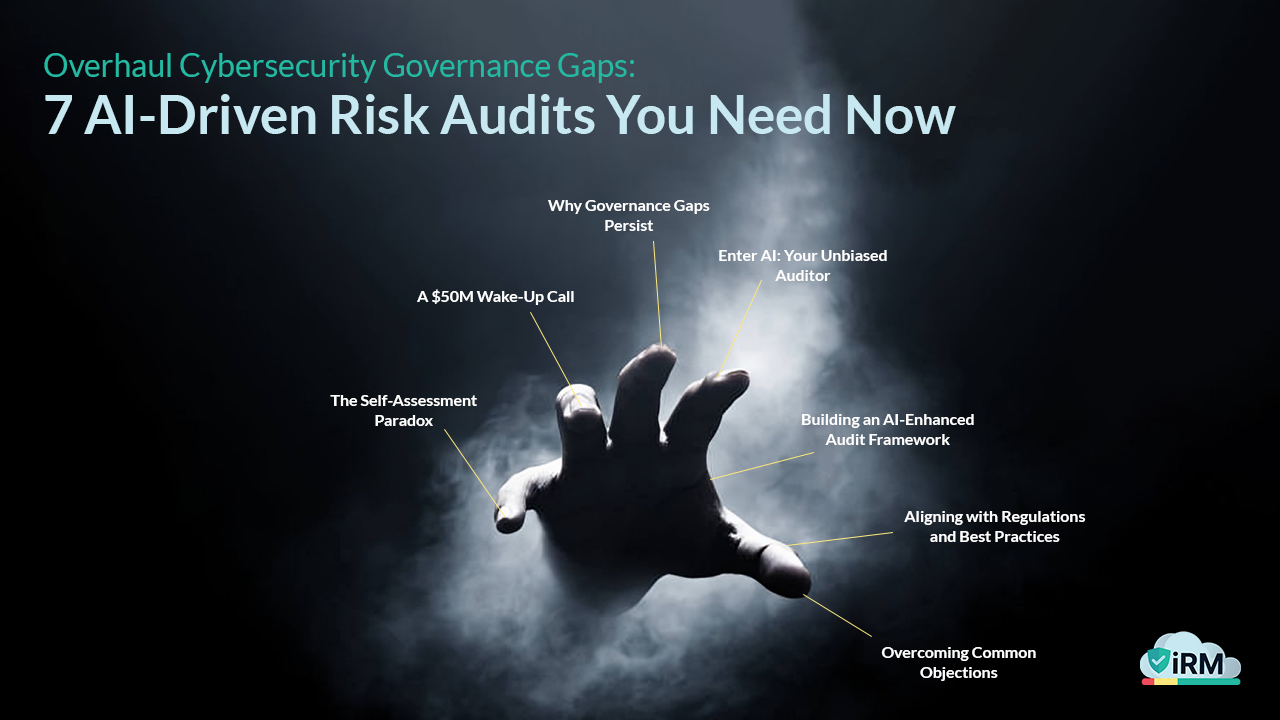
Enter AI: Your Unbiased Auditor
AI audits aren’t about replacing humans—they’re about shining a flashlight into the dark corners that self-assessments skip. Anomaly-detection tools watch for odd behavior across networks without relying on pre-set rules, catching threats that human checklists miss. Continuous monitoring bots scan your vendor ecosystem daily, alerting you the moment a new vulnerability appears. And objective scoring engines analyze thousands of data points—patch levels, configuration settings, threat intel—to assign risk ratings free from human optimism.
Actionable Insight: Pilot an AI anomaly-detection tool on your most critical network segments for 30 days. Compare those findings to your latest self-audit to see how much risk went invisible.
Building an AI-Enhanced Audit Framework
- Define Risk Ownership: For every asset and vendor, assign a single executive owner who reviews AI findings weekly.
- Set Trigger Thresholds: If AI scores a system’s risk above 70%, it auto-generates a ticket for immediate remediation.
- Human Validation: Security analysts validate AI-flagged issues, adding context before communicating to leadership.
- Feedback Loop: Outcomes feed back into the AI model, refining its detection logic over time.
This “AI + Human” loop ensures that automated scans become smarter, and human teams stay focused on the highest-priority issues.
Aligning with Regulations and Best Practices
Regulators have noticed the promise of AI in audits. NIST’s 2025 AI-audit guidelines now recommend explainable AI models in risk management, so you can clearly show auditors how each finding was reached. The penalties under GDPR have soared, approaching €6 billion, often tied to vendor-risk lapses that went uncovered in self-reports. Likewise, the SEC’s new push for real-time cyber-risk disclosures means outdated quarterly slides no longer cut it.
Meeting these evolving standards doesn’t have to be painful. Think of AI audits as compliance accelerators: they produce exportable findings that map directly to regulatory clauses. When a GDPR inspector asks for evidence of vendor due diligence, your AI audit report shows exactly when and how each provider was assessed. And if the SEC demands immediate proof of a patch applied this week, your real-time dashboard has the timestamp and logs at your fingertips.
Actionable Insight: Map your audit process to NIST’s AI governance framework and schedule a policy update session to bake AI findings into your compliance playbook.
Overcoming Common Objections
Teams often push back: “AI is too complex,” or “We don’t have the budget.” But consider this:
- High Breach Costs: A single breach can easily top $10 million—including downtime, fines, and reputational damage. AI audits can pay for themselves by preventing just one major incident.
- Missed Gaps: Industry surveys reveal human-only audits miss more than half of critical vulnerabilities. AI fills that blind spot.
- Early Adopter Advantage: Leading banks and tech firms already rely on AI anomaly tools to meet SEC and GDPR requirements—and tout faster response times and tighter compliance.
Actionable Insight: Run a cost-benefit analysis: estimate your average breach cost versus AI audit subscription fees. The math usually favors automation.
Your First Steps Toward AI-Driven Transparency
- Inventory Your Vendors: Use a digital tool to list every third party and its security posture.
- Select an AI Audit Partner: Compare platforms—Darktrace, MITRE AI Auditor, and iRM’s engine—on ease of integration and explainability.
- Run a Parallel Audit: Conduct your next self-assessment alongside an AI-backed audit.
- Report Findings to the Board: Show leadership the discrepancies and proposed AI-driven process.
- Schedule Ongoing Reviews: Embed AI audits into monthly governance cadences.
These steps will spotlight hidden risks and build trust that your security posture truly stands up to scrutiny.
Stop Trusting Biased Self-Reports—Transform Risk Evaluation with AI Audits
Every unchecked blind spot is a breach waiting to happen. Move beyond self-assessment failures and close your cybersecurity governance gaps with impartial insights from AI-driven risk audits.
Transform Your Governance with iRM’s AI Audits → Contact Us today