.png)

Resilience Roadmap: Navigating Business Continuity with Confidence
What’s Business Resilience? (Why It Matters Now More Than Ever)
Business resilience is like having a safety net when the world feels unstable. It’s about staying afloat during disruptions—whether it’s a global supply chain crisis, a cyberattack, or even a sudden shift in consumer preferences. In 2025, companies face bigger challenges than ever. For instance, a 2025 report by Gartner highlights that 60% of businesses now face “no margin” challenges, where profit margins are so thin that even minor disruptions can cripple operations
Take the example of a small bakery that lost its main flour supplier during a 2025 climate-driven drought. Without a backup plan, they’d shut down—but with resilience strategies, they had a second supplier lined up. This isn’t just about survival; it’s about thriving. Companies that communicate their plans clearly and involve employees report 40% higher customer trust post-crisis
Building Your Foundation: The Basics of Business Continuity Planning (BCP)
Let’s break down BCP into bite-sized steps. Think of it like planning a trip: you need a map, a budget, and a team. Here’s how to start:
Step 1: Identify Risks (Start with a Business Impact Analysis)
A Business Impact Analysis (BIA) is your cheat sheet for spotting weak spots. It’s like asking, “What if?” but with data. For example:
- Which operations are most critical? (e.g., a bakery’s oven vs. its website).
- How long can we afford to be offline? (e.g., 24 hours vs. 7 days).
- What’s the financial hit if we stop? (e.g., $5K/day in lost sales).
In 2025, BIA tools like Riskonnect automate this process, helping even small businesses pinpoint vulnerabilities
Step 2: Assign Roles
Who handles customer complaints if your website goes down? Who manages remote work logistics? Clear roles prevent chaos. Tools like Datto Unified Continuity (2025’s top-rated BCP software) help automate these assignments
Step 3: Test Your Plan
Hold drills. Pretend your office floods—could your team work remotely? Use free apps like Slack or Microsoft Teams to simulate communication. The ISO 22301 standard ensures your plan is thorough, even for small businesses
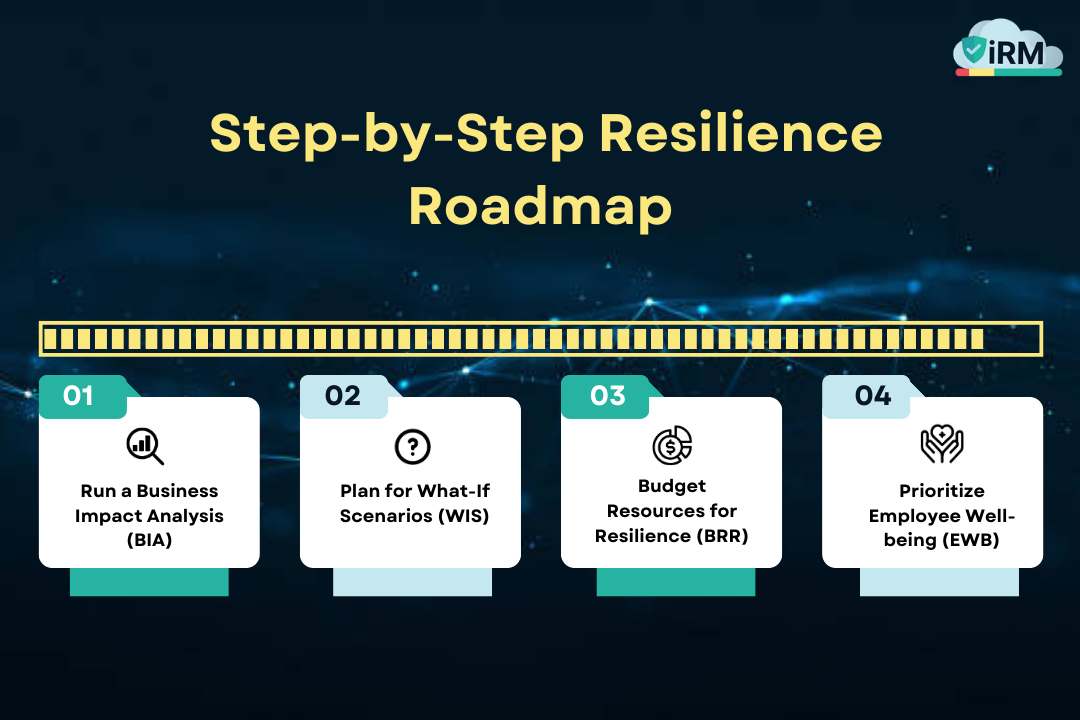
Our Step-by-Step Resilience Roadmap
Creating a resilience roadmap is like planting a garden: you need the right seeds, soil, and patience. Here’s how to grow yours:
Step 1: Run a Business Impact Analysis (BIA)
Start here! A BIA answers:
- What’s mission-critical? (e.g., a bakery’s flour supplier vs. its social media team).
- What happens if it fails? (e.g., 24-hour shutdown vs. 2-day delay).
- How long to recover? (e.g., 1 week vs. 1 month).
Use free templates or tools like Forms.app to map out impacts
Step 2: Plan for “What-Ifs”
Imagine scenarios:
- What if your supplier can’t deliver? (Use BIA findings to prioritize backup vendors).
- What if your IT system is hacked? (Invest in cybersecurity tools like CrowdStrike, based on BIA risk scores ).
Step 3: Budget Smartly
Even a $20/month cloud backup (like Dropbox or Google Drive) can save you thousands in downtime. In 2025, 80% of businesses prioritize “no margin” protection by allocating 2–3% of revenue to resilience tools
Step 4: Stay Human
Employee well-being is now a top trend. Burned-out teams can’t pivot during crises. Offer mental health days and flexible hours—companies that do this see 25% faster recovery times
Real-Life Wins: How Companies Stayed Afloat in 2025
Let’s look at companies that turned crises into opportunities:
Case 1: The Tech Startup’s Data Breach
A 2025 data breach hit a startup’s customer database. Their BCP included AI-driven tools to detect threats early and a “scenario plan” for data recovery. But first, their BIA had flagged customer data as a top priority, so they prioritized restoring it. Within hours, they apologized publicly and offered free credit monitoring. Their honesty turned a crisis into a trust-building moment
Case 2: The Coffee Chain’s Climate Challenge
When a major coffee supplier faced drought in 2025, a chain used a BIA to identify backup growers in Ethiopia and a mobile app to redirect customers to open stores. Their BIA had ranked “supply chain delays” as the #1 risk, so they were ready
Case 3: The Retailer’s Supply Chain Hack
A clothing retailer’s supplier was hit by ransomware. Their BIA had flagged “cyberattacks” as a top threat, so they quickly switched to verified alternatives. No delays, no lost sales
Common Pitfalls (And How to Avoid Them)
Even the best-laid plans can fail. Here’s what to watch for:
- Pitfall 1: Skipping the BIA -Over 40% of small businesses still skip BIA, assuming it’s too technical But tools like DataGuard simplify it—just answer questions about your operations
- Pitfall 2: Ignoring Employee Burnout - Stressed teams can’t think clearly. Offer wellness programs, like free counseling or mindfulness apps. Companies that do this see 30% faster crisis recovery
- Pitfall 3: Not Updating the BIA - Risks change—and so should your BIA. Re-run it yearly or after major events (e.g., a new office opening). A 2025 study found this cuts response time by 50%
Tech Tools That Save the Day in 2025
You don’t need a tech budget the size of a Fortune 500 company. Here’s what works:
- BIA Software: Tools like Riskonnect or Forms.app automates impact assessments.
- AI-Powered Alerts: Darktrace detects cyber threats in real-time, prioritizing risks flagged in your BIA.
- Climate Risk Tools: Apps like ClimateAi predict weather disruptions for supply chains, aligning with BIA findings.
Even a local bakery uses a free app to track supplier delays and order backups in time.
How Do You Know If It’s Working?
Track your progress like a fitness app. Here’s what to measure in 2025:
- BIA-Driven Metrics: Compare actual downtime vs. BIA predictions. Did you recover faster than expected?
- Customer Feedback: “Did we stay in touch during the outage?”
- Team Morale: Use anonymous surveys to gauge stress levels.
Key Metrics from Experts :
- Operational Compliance: Are teams following BCP steps?
- Quality Scoring: How well did your recovery match BIA goals?
- Program Maturity: Are you improving each year?
In 2025, companies will use AI tools like LogicManager to auto-generate these reports
Ready to Start Your Journey?
Resilience isn’t a one-time task—it’s a habit. Here’s how to begin:
- Audit Your Plan: Use a BIA template to list gaps. For example, “Do we have backup suppliers?”
- Ask for Help: Experts like TO iRM can guide you through tricky parts.
Imagine this: In 2026, a crisis hits. Your team springs into action, customers stay loyal, and you’re the hero who kept the business going. That’s resilience in action.
Your Next Move (2025 Edition)
Start small today:
- Run a Mini BIA: Use a free template to map 1–2 critical operations.
- Tech Upgrade: Spend $20 on cloud storage.
- Check Tools: Explore free versions of 2025’s top BCP software (e.g., Datto, ParaSolution).
Still unsure? Share your biggest worry with us—we’ll help brainstorm solutions! Don’t wait for a crisis to hit. Contact us now and turn “what ifs” into “we’ve got this.”