.png)

Risk Appetite Revealed: Defining and Communicating Your Risk Boundaries
Hey, cybersecurity heroes and risk management rockstars! If you’re a CISO, risk manager, compliance officer, or IT leader, you know risks can pop up faster than you can say "firewall." That’s why we’re here with Risk Appetite Revealed: Defining and Communicating Your Risk Boundaries—to help you set clear risk limits and get everyone on the same page.
We’re tossing in fresh trends like AI-powered risk sizing and 2024’s latest rules, paired with simple, do-it-now steps. Our mission? Make iRM your trusted guide with a vibe that’s friendly yet firm, shouting, “This is urgent, but we’ve got your back!”
Let’s roll!
The High-Stakes Game of Risk Appetite
Imagine this: it’s 2024, and data breaches are slapping companies with a hefty $4.88 million tab on average, a 10% jump from last year, says IBM’s Cost of a Data Breach 2024 report. Yikes! That’s what blurry risk boundaries do—leave you wide open. Research hints that 60% of breaches come from misaligned risk tolerance, meaning if you don’t know your limits, chaos creeps in. For you pros, this is your signal to match risk plans with business goals. Picture your team jumping into shiny new tech without a risk cap—hackers would have a field day. That’s where enterprise risk management and cybersecurity governance come in to save the day.
- Why It Matters: Undefined risks cost millions—literally.
- Your Role: Align risks with what your company wants to achieve.
- Real Talk: Vague boundaries = hacker paradise.
Defining Risk Appetite vs. Risk Tolerance
Let’s keep it simple. Risk appetite is your big “how much risk can we handle?” question—like how much wiggle room your organization wants to grow. Risk tolerance is the small print, the exact “nope, that’s too far” lines. Think of a bank: they might be fine with some credit risk to make cash (appetite), but they’ll cap bad loans tight with credit checks (tolerance). In healthcare, safety is king, so tolerance for mess-ups like medical errors is zero. ISO 31000 backs this up, giving you a solid way to set those lines. Here’s a tip: Grab a pen and map your risk appetite framework with your industry’s quirks—it’ll hit home.
- Appetite 101: The overall risk you’re okay with.
- Tolerance 101: Specific limits for specific stuff.
- Action Step: Sketch your own risk map today.
The Role of AI in Quantifying Risk Appetite
AI’s your new risk-busting buddy—it digs into data, finds patterns, and guesses what’s coming. Take Oracle Fusion’s predictive analytics: it sorts out collections, boosts cash flow, and sharpens your risk view. Imagine a store using AI to predict inventory—too much stock’s risky, but AI uses past sales to set a safe spot. For you, this means using AI to peek at things like customer patterns and draw smarter risk lines. Try this: Run some AI reports to spot your risk zones—decisions get way clearer, fast.
- AI Magic: Turns data into risk predictions.
- Case in Point: Oracle helps cash flow and risk smarts.
- Your Move: Test AI tools for quick risk insights.
Communicating Risk to Non-Technical Stakeholders
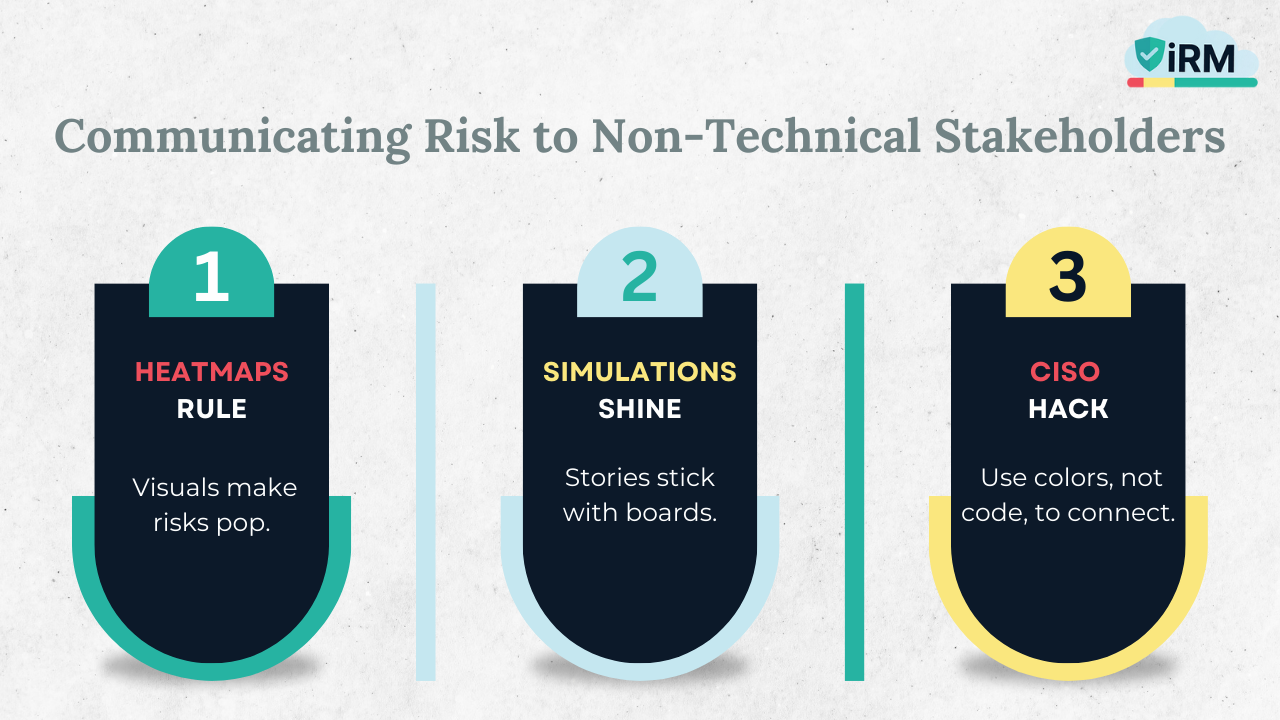
Ever feel like you’re explaining risks to your board in a different language? We’ve got fixes. Heatmaps—think risk GPS—show threats by how likely and how bad, all in bright colors (cheers to NIST for the idea!). Scenario simulations are your “what if” tales—like, “What if a breach hits?”—making it click for non-techies. As a CISO, flash a heatmap with a red “uh-oh” zone to wake them up, no geek-speak required. Do this: Next meeting, show a heatmap and play out a quick “what if”—they’ll get it.
- Heatmaps Rule: Visuals make risks pop.
- Simulations Shine: Stories stick with boards.
- CISO Hack: Use colors, not code, to connect.
Regulatory Pressures Shaping Risk Appetite
It’s been a wild ride with rules. GDPR upped fines—like €390 million for a social media bigwig—pushing data protection hard. The SEC says public companies must spill cyber incidents in four days flat, shaking up risk plans. NIST’s Cybersecurity Framework 2.0, out since February 2024, tossed in a “Govern” bit, zooming in on supply chains. These shifts mean your risk appetite’s got to bend to stay legal. Here’s a step: Double-check your compliance setup—tweak your risk limits so you’re safe.
- GDPR Sting: Big fines mean tight data rules.
- SEC Speed: Four days to report breaches—yep.
- NIST News: Governance now covers more ground.
Case Study: When Risk Appetite Failed
Flashback to 2020: SolarWinds. Hackers snuck bad code into their software, hitting thousands—including government folks—and costing millions. Why? Their risk lines were too soft, leaving holes. It’s a screaming reminder: loose boundaries, especially with vendors, spell trouble. Your takeaway: Audit your supply chain, lock it down, and let SolarWinds be your warning sign.
- What Went Wrong: Soft risk limits let hackers in.
- Lesson Learned: Vendors need tough checks.
- Fix It: Audit every link in your chain.
Building a Risk-Aware Culture
Risk isn’t just for the big shots—it’s everyone’s game. Kick off with training for risk analysts and compliance officers, leaning on setups like ISO 31000 or NIST to sharpen them up. Leaders gotta lead—think monthly risk talks—and make it okay to shout out problems. Picture your crew nailing a phishing email early because they’re clued in—that’s the dream. Try this: Launch a risk training day for all and set up a risk hotline—build that “we’re on it” spirit.
- Team Power: Everyone needs risk smarts.
- Leader Duty: Set the tone with regular chats.
- Win Scenario: Trained staff stop trouble early.
Future Trends: Quantum Risks and AI Governance
Heads up—the future’s wild! Quantum computing could smash today’s encryption, so NIST’s pushing quantum-proof fixes you’ll need soon. AI governance is buzzing too—bias and privacy risks are real, with rules like the EU AI Act (live since August 2024) stepping in. For 2025, prep now: dig into these threats and stay sharp. Your plan: Host a quantum risk workshop and write an AI policy—stay ahead of the curve.
- Quantum Scare: Encryption’s at risk—act fast.
- AI Watch: Rules are tightening on AI risks.
- Prep Now: Workshops and policies keep you ready.
Risk Metrics That Matter
How do you know your risk appetite is working? Metrics! Track stuff like breach costs (aim to keep them under that $4.88 million average), incident frequency, or how fast you spot risks. For CISOs, these numbers show if your boundaries hold up. Check this: Set up a dashboard with these stats—watch your risk game tighten.
- Cost Check: Keep breaches below the norm.
- Speed Test: Spot risks quickly—how fast are you?
- Dashboard Tip: Track it all in one spot.
Tools to Sharpen Your Risk Game
You don’t have to go it alone—tools help. Beyond heatmaps and AI, think of risk software like Archer or ServiceNow to track threats in real-time. They tie into your risk management framework and make life easier. Pick one: Test a tool next quarter—see how it boosts your clarity.
- Software Boost: Real-time risk tracking rocks.
- Top Picks: Archer or ServiceNow—try ‘em.
- Easy Win: Plug it into your setup.
Your Next Step Starts Here
There you go—clear risk boundaries aren’t optional; they’re your armor against multi-million-dollar disasters. From AI hacks to new rules, past flops, and future threats, you’ve got the know-how to set and share risk limits like a champ.
Don’t wait for a breach to happen to you—let iRM’s crew craft your perfect plan. Swing by our Contact Us page today and sidestep tomorrow’s headlines!